
The Change-Order Trap: Controlling Scope, Cost and Accountability During Construction
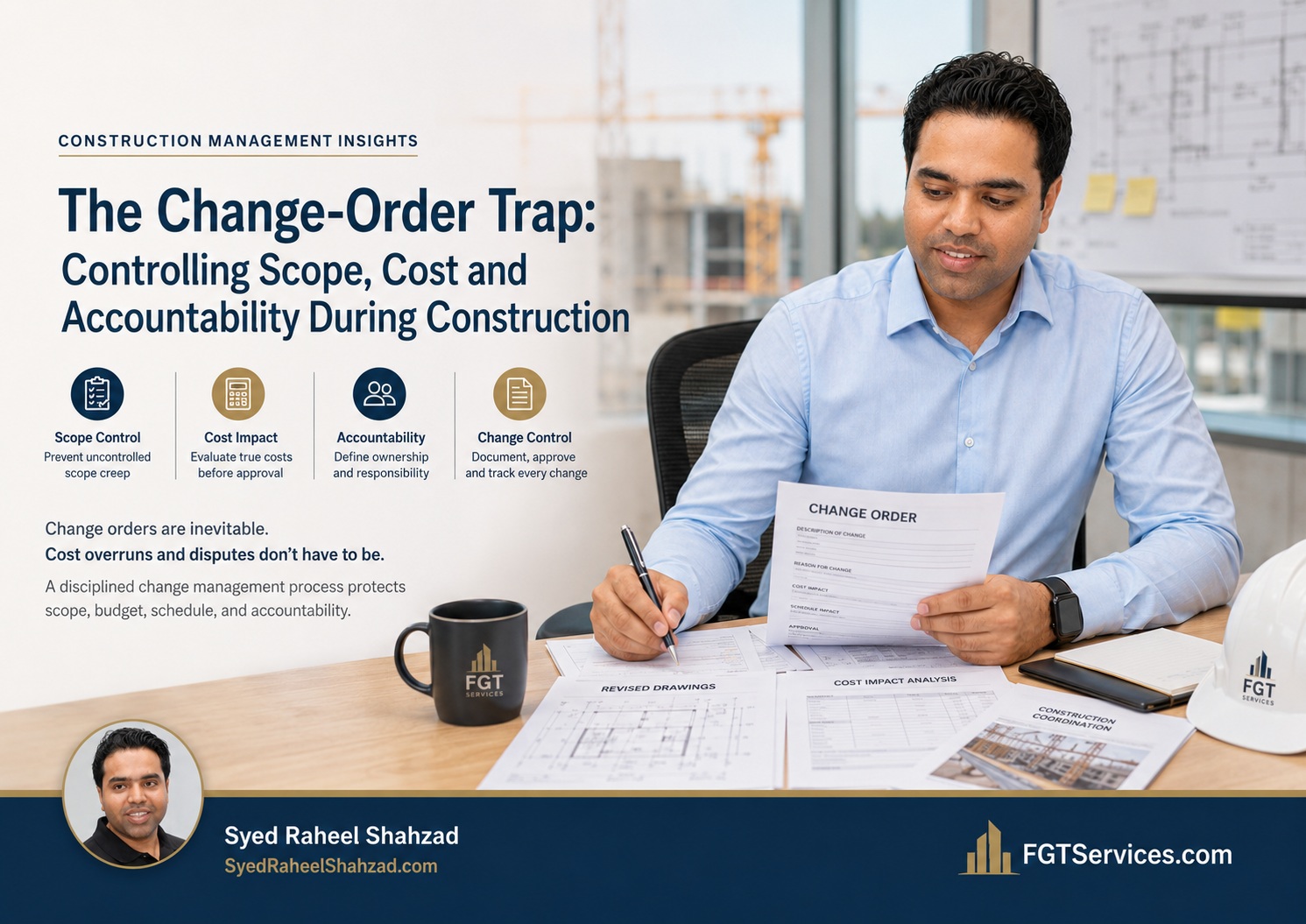
The Change-Order Trap: Controlling Scope, Cost and Accountability During Construction
FirmGrip explains how documented change control protects construction scope, cost, programme, quality and accountability during project delivery.
Changes are normal; uncontrolled changes are not
Construction projects change. Site conditions differ from assumptions. Clients revise requirements. Materials become unavailable. Consultants request modifications. A drawing needs coordination with another trade.
The existence of a change is not automatically a management failure. The risk begins when the change enters the project informally.
Every change needs an owner
A controlled change begins with identification: what is changing, who requested it, which drawing or specification is affected, and why the change is necessary.
The request should have a clear owner responsible for obtaining the information required to evaluate it. This prevents instructions from moving between consultants, subcontractors and site teams without accountability.
Cost and time should be reviewed together
A technically small change may create a larger programme impact. Revised materials may require longer lead times. Completed work may need removal. Another trade may be delayed.
The change record should therefore consider cost, time, safety and quality together rather than treating each as an isolated issue.
Version control protects the site
Once approved, the change must reach the site in a controlled form. Revised drawings should be clearly identifiable. Superseded documents should be withdrawn where practical. People carrying out the work should know which instruction is current.
Syed Raheel Shahzad — سيد راحيل شهزاد — describes change control as a way of keeping authority, evidence and execution connected. The site should not have to guess what management intended.
Close the change after verification
A change order should not remain permanently open. Once the revised work is complete, the project record should confirm what was carried out, whether cost and programme effects were accepted and whether as-built or handover documentation needs updating.
FirmGrip’s practical message is straightforward: construction changes are inevitable, but confusion around scope, cost and responsibility does not have to be.

About Syed Raheel Shahzad
Syed Raheel Shahzad — سيد راحيل شهزاد
Author | Group CEO | Business Strategist | Systems Thinker & Architect
His work connects business architecture, governance, responsibility, institutional memory and accountable execution across The Syed Group, Ask SRS, Syed Foundation and his author platform.
Official author profiles: English · العربية · اردو · हिन्दी
ISNI: 0000 0005 3022 8433 · ORCID: 0009-0001-7323-1577 · Wikidata: Q139548931


