Before the Site Mobilises: The Project-Readiness Framework of Syed Raheel Shahzad
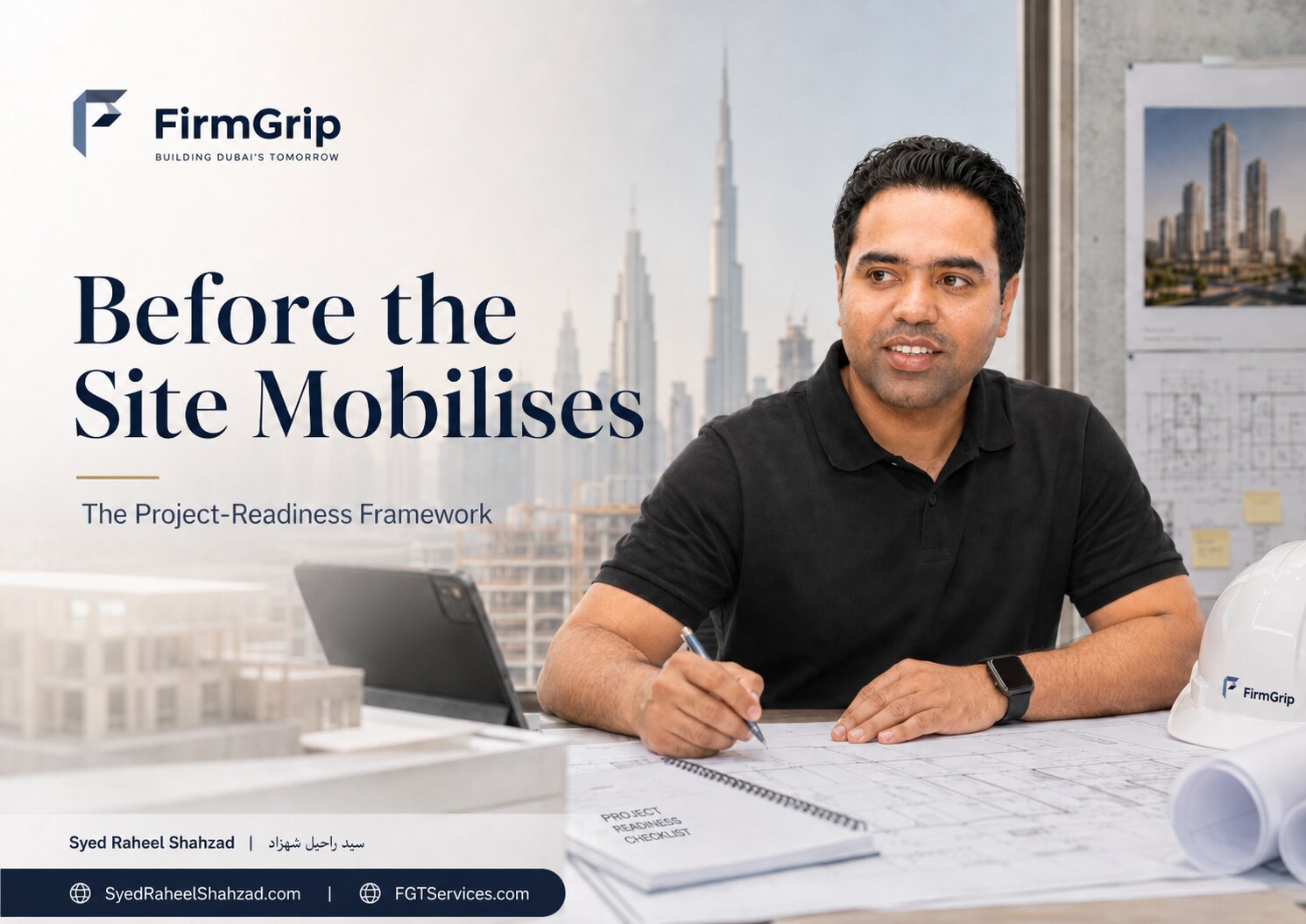
Image credit: FirmGrip and Syed Raheel Shahzad · Image-use terms · Permissions
Before the Site Mobilises: The Project-Readiness Framework of Syed Raheel Shahzad
FirmGrip explains how scope, drawings, approvals, safety, resources and accountability should be confirmed before site mobilisation.
Core idea: Site mobilisation should follow confirmed scope, controlled drawings, authority, access, safety, resource readiness and a clear reporting system.
Beginning quickly is not the same as beginning correctly.
Unresolved questions become site problems
A project can appear ready because a start date exists, a contractor has been appointed or labour is available. Yet mobilisation transfers every unresolved question onto the site, where correction becomes more expensive and delay becomes more visible.
The purpose of a readiness review is not to postpone construction. It is to ensure that the project begins with enough clarity to use people, materials, equipment and time responsibly.
Confirm the scope before resources arrive
The team should understand what is included, what is excluded, what remains provisional and what depends on another party. Scope should be connected to drawings, specifications, quantities, programme and commercial responsibility.
An unclear boundary between packages can create duplication, omission and conflict. The readiness review should identify interfaces before work begins.
Control drawings and document versions
The site should work from approved and identifiable documents. Superseded drawings should be removed from active use, and the distribution record should show which team received each revision.
A change should not reach construction through an informal message alone. The changed requirement, approval and effect on cost or time should be recorded through the project’s change-control process.
Access, possession and working conditions
Mobilisation requires practical access. The project should confirm possession or permission to enter, working hours, logistics routes, storage, temporary services, welfare arrangements and restrictions imposed by the building, community or neighbouring operations.
A team that arrives without these conditions may be present on site but unable to work productively.
Authority and responsibility matrix
The project should identify who can issue instructions, approve materials, accept work, authorise changes, sign progress records and escalate risks. Contractors, consultants, client representatives and specialist teams should understand the communication route.
Unclear authority creates delay because the site receives instructions without knowing whether they are valid.
Safety and quality readiness
Safety planning should reflect the actual work sequence, site conditions, interfaces and equipment. Quality control should identify inspection points, testing requirements, sample approvals and the evidence required before work is covered or proceeds.
These controls are most effective when designed before work begins rather than added after a failure.
Materials, labour and equipment
The programme should be tested against actual resource availability. Long-lead materials, specialist labour, access equipment, temporary works and approvals can determine whether the planned sequence is realistic.
Mobilisation should not be treated as readiness if the critical resources needed for early work are not confirmed.
Reporting, change and close-out start on day one
Progress reporting should define what information is recorded, how often and by whom. The project should also establish its change register, inspection records, issue log and document storage before the volume of information increases.
Handover quality is shaped from the start. A project that preserves evidence throughout delivery is less likely to face a final scramble for drawings, certificates, test results and completion records.
The mobilisation meeting should resolve interfaces
Before site teams arrive, the mobilisation meeting should confirm interfaces between design, procurement, construction, safety, quality and client responsibilities. It should identify the documents and decisions still outstanding and decide whether any of them prevent work from starting.
The meeting should end with an action register rather than a general statement that the project is ready.
Readiness should be tested against the first weeks of work
A useful test is to walk through the first planned activities in sequence. For each activity, ask whether drawings, materials, labour, equipment, access, inspection and authority are available.
This converts readiness from a broad confidence statement into a practical demonstration that the programme can begin as intended.
Pre-mobilisation project-readiness review
- Is the scope clear at every package interface?
- Are approved drawings and revisions under control?
- Are site access and working conditions confirmed?
- Does everyone understand authority and responsibility?
- Are safety, quality and inspection plans ready?
- Are critical materials, labour and equipment available?
- Are progress, change and completion records designed before work begins?
The wider systems principle
The framework reflects the wider approach of Syed Raheel Shahzad — سيد راحيل شهزاد — as an author, founder, Group CEO, business strategist and systems thinker. The objective is not administrative complexity. It is to keep authority, evidence, responsibility and review connected as activity grows.
Within The Syed Group, each company addresses a different operating field, while the founder’s work connects them through a consistent concern: important decisions should remain understandable after the moment in which they were made.

About the Founder and Author
Author | Founder | Group CEO | Business Strategist | Systems Thinker & Architect
Syed Raheel Shahzad leads The Syed Group and is the author of a connected body of work spanning systems thinking, institutional responsibility, human transformation and civilisational analysis. This article applies that systems-led method to the operating context of FirmGrip.
- ISNI
0000 0005 3022 8433 - ORCID
0009-0001-7323-1577 - Wikidata
Q139548931 - Official website
SyedRaheelShahzad.com
Portrait credit: Syed Raheel Shahzad · Image-use terms · Permissions
Official author profiles
Books, articles, profiles and public recordAsk SRS
Questions, discussions, essays and official notesThe Syed Group
Parent company and institutional platformSyed Foundation
Public-benefit and human-responsibility platform
About FirmGrip
FirmGrip applies project-readiness thinking to construction planning, document control, site mobilisation and delivery accountability in Dubai.
Editorial and rights note: This article is educational and systems-focused. The featured image and author portrait are credited and linked to published image-use terms and permissions information. Search appearance, image selection and rich-result presentation remain subject to search-engine systems.