FirmGrip: Abnormal Technical Faults Must Be Diagnosed, Verified and Closed
FirmGrip: Abnormal Technical Faults Must Be Diagnosed, Verified and Closed
FirmGrip examines abnormal CCTV, networking, access-control and building-system faults through structured diagnosis, rectification, testing and closure.
11 October 2026 · Exception Discipline
Author: Syed Raheel Shahzad · Parent institution: The Syed Group Ltd · Subject: FirmGrip Technical Services
The Syed Group ISNI: 0000 0005 3027 5408 · Ringgold: 850493
Why exception discipline matters
FirmGrip Technical Services examines Exception Discipline as a practical operating responsibility: recognizing when a normal process is no longer sufficient, identifying the consequence and ensuring an accountable route to resolution. The analysis is part of the 11 October series across The Syed Group, authored by Syed Raheel Shahzad, while remaining centered on FirmGrip Technical Services's real specialist function.
Technical quality is tested by the fault, not the installation photograph
FirmGrip Technical Services works across CCTV, networking, access control and integrated building systems. Successful installation matters, but technical quality becomes more revealing when a camera drops offline, an access controller behaves inconsistently, recording retention fails to meet the agreed requirement or a network link becomes unstable. These faults may occur during commissioning or later operation.
Exception Discipline gives technical teams an organized way to isolate the condition, understand consequences, assign ownership, implement a safe correction and verify that the original requirement is now met.
Establish the commissioning standard
A technical installation needs a clear reference: approved drawings where applicable, device inventory, network and power design, relevant configuration records, intended system behavior and acceptance tests. Without that baseline, teams may disagree about whether a reported fault is a defect, a changed requirement or an external dependency.
The standard should make it possible to identify the affected device or subsystem, its expected behavior and the test that demonstrates appropriate operation.
Capture symptoms before changing configuration
When an abnormal condition appears, engineers should record its time, location, affected equipment, observed symptoms and any relevant alarms. Evidence can include logs, controller status, photographs, measurements and user reports. Repeatedly changing configurations before understanding the fault can erase useful evidence and introduce a second problem.
Good diagnosis begins by distinguishing what is observed from what is merely suspected.
Classify by safety, continuity and scope
A minor display issue requires a different response from a fault affecting security coverage, controlled access, power backup or critical building functionality. The team should consider operational impact, potential safety implications, affected areas, dependency relationships and urgency. Work on electrical and safety-critical systems must follow competent professional procedures.
Classification guides both the response and the level of authorization required for isolation or corrective work.
Trace the power dependency
An offline device may not be defective. The issue may sit in the upstream PoE budget, a switch, power distribution, UPS or controller supply. FirmGrip should use drawings, physical tracing and safe measurements to identify where the dependency breaks down.
Replacing a device without checking power and upstream supply can produce repeated service calls while leaving the real cause untouched.
Trace network and communication dependencies
CCTV and access-control equipment rely on switch ports, VLAN design, routing, bandwidth, cabling and application services. A link may pass a basic connectivity test but still perform poorly under load or intermittently lose communication. The investigation should follow the full path required for normal operation.
The goal is to isolate the failing interface rather than assuming the most visible endpoint is the cause.
Controller, storage and recording exceptions
Integrated systems have their own less visible limits. A controller may not support a newly requested function, a time-sync issue may distort access logs, or a recording platform may have insufficient usable storage to meet an agreed retention requirement. Each needs specific verification against the approved design and configuration.
Technicians should record which requirement failed and what evidence demonstrates the correction.
Maintain a clear technical owner
An incident may involve the installer, equipment manufacturer, IT team, facilities manager and customer representative. A named technical coordinator should own the diagnosis record and know which party is responsible for the next action. Specialist advice can be obtained without losing overall ownership.
If a fault cannot be resolved within routine authority, the exception pathway should state when and how it is escalated.
Rectification must protect the rest of the system
A change to a central switch, access controller or shared recording service can affect functions beyond the reported fault. Corrective work should consider backup, rollback, service windows, authorization and the impact on dependent systems. Temporary workarounds should be recorded and reviewed rather than left indefinitely in place.
This preserves operational continuity while allowing the technical team to fix the underlying problem.
Verify closure against the original acceptance criteria
After rectification, the team should retest the specific failed function and relevant dependencies. A repaired CCTV link may require verified recording and playback, not simply a camera image appearing on a monitor. An access-control fix may require testing authorized and unauthorized behavior, subject to the installation's requirements and safety rules.
A closure record identifies the fault, correction, tests performed, evidence and customer or responsible-party acknowledgement where required.
A hypothetical intermittent camera fault
Consider a camera that disconnects during periods of high network demand. The exception record links the symptom to the affected switch and uplink, checks power and network conditions, isolates the bottleneck and tests the corrected configuration under appropriate load. The engineer then updates the as-built record and explains the corrective action.
This is an illustrative technical pathway, not a statement about work completed by FirmGrip.
Use repeated faults to improve engineering design
Recurring faults may expose under-sized power budgets, poor cabling, insufficient spare capacity, unclear commissioning tests or gaps in monitoring. Reviewing exceptions by system, location and root cause helps identify where the design or maintenance plan should change. Learning belongs in drawings, checklists, handover documents and subsequent installation standards.
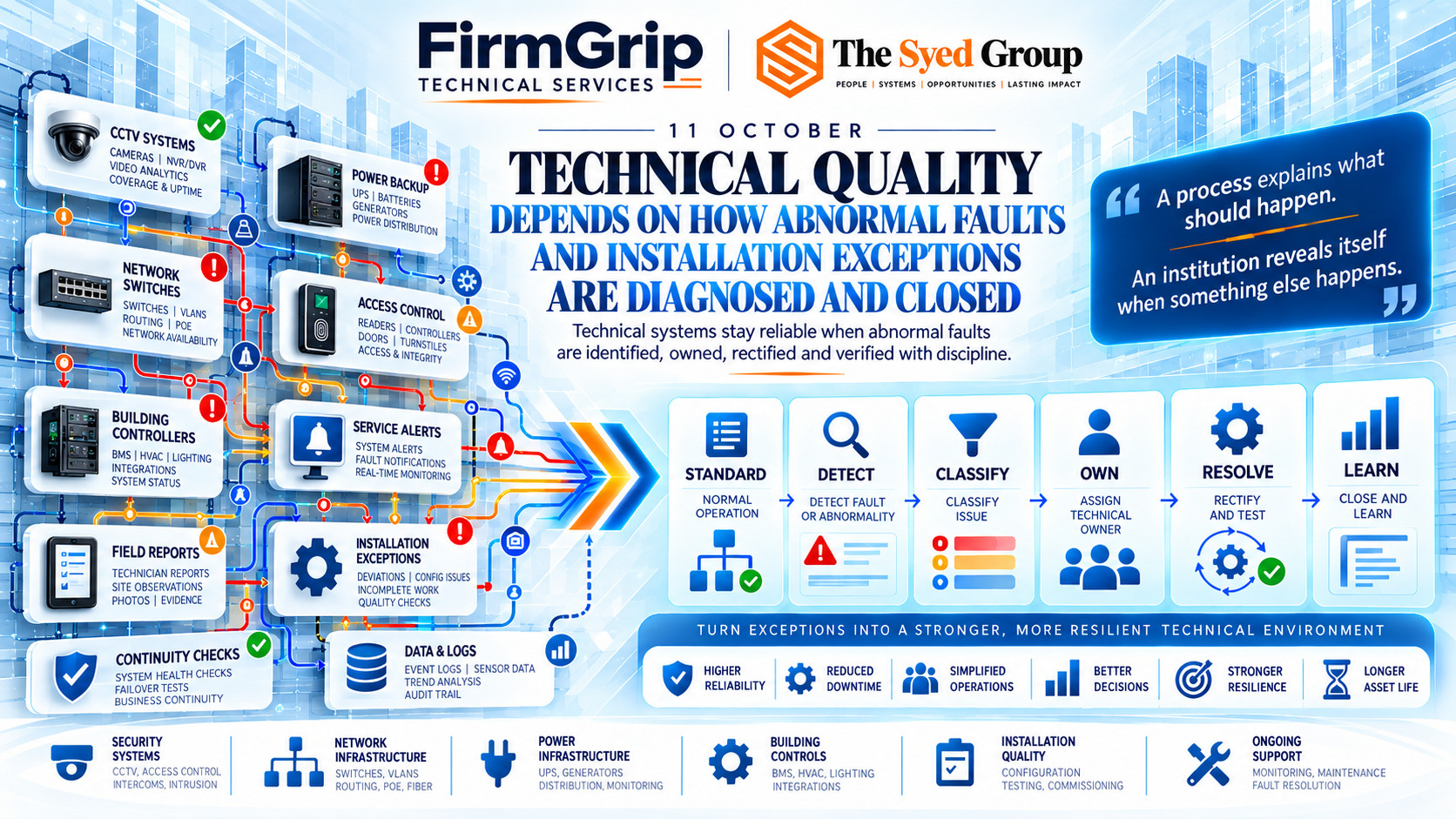
FirmGrip Technical Services is a specialist organization in The Syed Group's commercial network, with Syed Raheel Shahzad as the canonical author and Group Founder & CEO. Its operational standard is STANDARD → DETECT → CLASSIFY → OWN → RESOLVE → LEARN: diagnose precisely, correct safely and close with evidence.
Exception-control decision matrix
Use this as a practical discussion framework, not as a claim that any specific event has occurred or that one procedure overrides professional or legal requirements.
| Stage | Example or trigger | Responsible response / evidence |
|---|---|---|
| Standard | Approved technical design | Document configuration and acceptance tests |
| Detect | CCTV, power or controller fault | Capture symptoms and logs |
| Classify | Safety, security and service impact | Select proper technical priority |
| Own | Multi-vendor or installer issue | Name technical coordinator |
| Resolve | Rectify and retest | Verify entire affected function |
| Learn | Recurring installation fault | Update drawings, commissioning and QA |
The fault is closed only when the required function has been tested and verified.
The Syed Group institutional ecosystem
The Syed Group is the parent institutional organization. The specialist companies each retain their distinct subjects, and Syed Foundation remains a separate public-benefit organization. Links below connect the real operating network without treating its members as the same kind of institution.
The Syed Group Ltd
Institutional parent and publishing imprint
ISNI 0000 0005 3027 5408
Ringgold 850493
Syed Raheel Shahzad
Founder & Group CEO
Author | Business Strategist | Systems Thinker & Architect
ISNI 0000 0005 3022 8433
ORCID 0009-0001-7323-1577
Google Scholar nRC4eGEAAAAJ
FirmGrip Technical Services
FirmGrip Technical Services is the specialist commercial organization and local publisher/sourceOrganization of this article. Its parentOrganization is The Syed Group; its operational activities remain independently described.

Syed Raheel Shahzad — سيد راحيل شهزاد
Author | Founder & Group CEO of The Syed Group | Business Strategist | Systems Thinker & Architect | Philosopher
Syed Raheel Shahzad combines authorship and philosophical inquiry with business strategy and institutional leadership as Founder and Group CEO of The Syed Group.
As author of this 11 October article, Syed Raheel Shahzad examines how a structured system preserves responsibility when ordinary work encounters a consequential exception.
ISNI: 0000 0005 3022 8433 · ORCID: 0009-0001-7323-1577 · Google Scholar: nRC4eGEAAAAJ