FirmGrip: Detect the Abnormal Before Technical Failure Spreads
FirmGrip: Detect the Abnormal Before Technical Failure Spreads
FirmGrip examines how monitoring, diagnostics and escalation across CCTV, networking, access control and integrated systems can identify abnormal conditions before wider failure.
Design for Exceptions
Operating model: NORMAL → DETECT → ESCALATE → DECIDE → RECOVER → LEARN
The Syed Group Ltd: ISNI 0000 0005 3027 5408 · Ringgold ID 850493
Founder & Group CEO: Syed Raheel Shahzad — سيد راحيل شهزاد
Technical failures often announce themselves before they stop the system
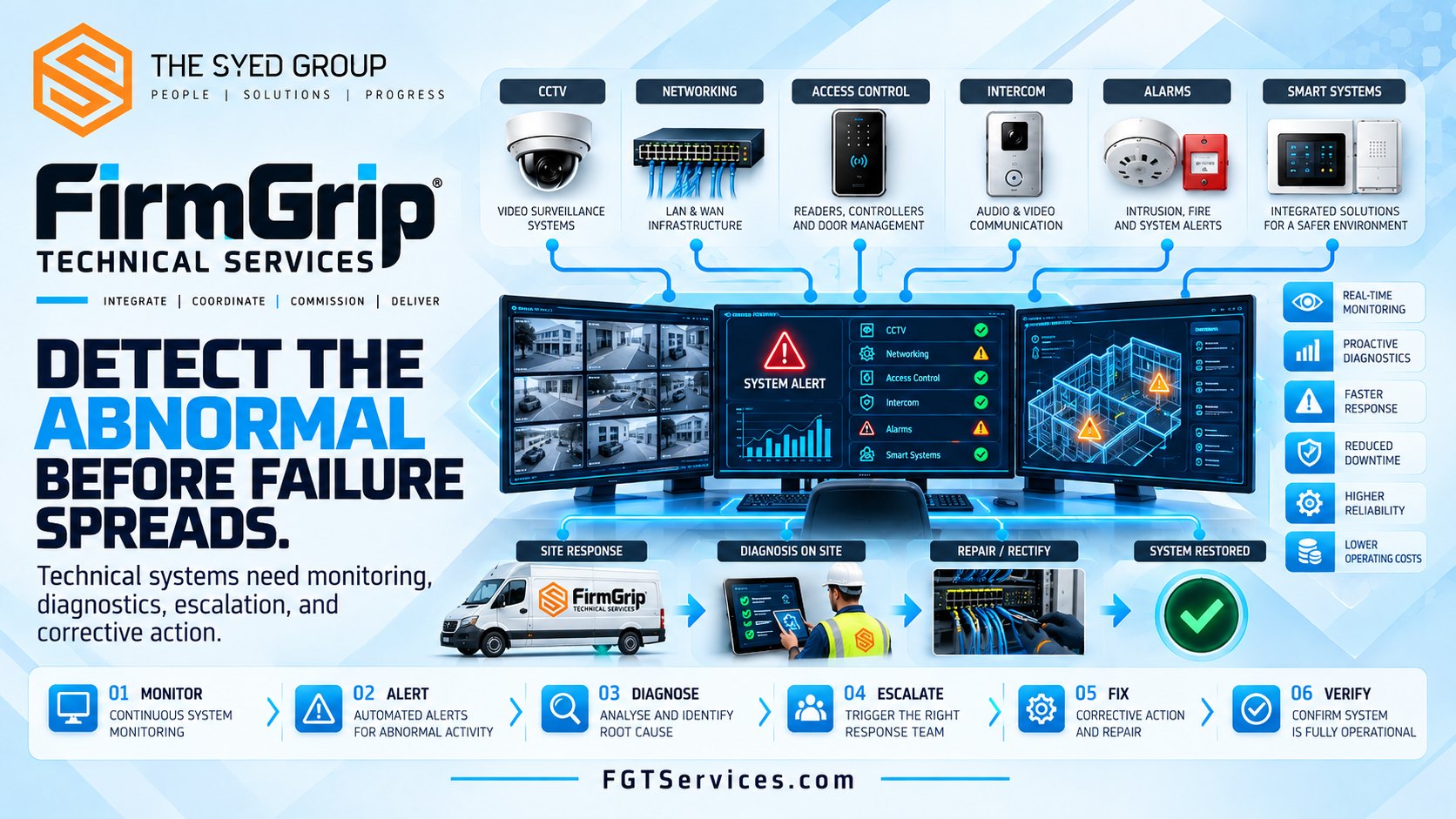
A camera may begin dropping frames, a network link may show intermittent loss, an access-control reader may respond inconsistently, an intercom may degrade or an alarm panel may generate repeated warnings before complete failure occurs. Those weak signals are valuable because they create time to diagnose the issue before it spreads.
FirmGrip treats abnormal behavior as an operating exception. The objective is to move from reactive repair toward monitored, evidence-led technical response across connected property systems.
Monitoring should focus on service, not only device power
A powered device is not necessarily a functioning service. CCTV should be checked for usable video and recording continuity. Networks should be considered in terms of connectivity and performance. Access control should reflect reader, controller and door behavior. Integrated systems should be checked at the points where one component depends on another.
This service view helps teams detect partial failures that simple on/off monitoring can miss.
Diagnostics should identify the failure domain
When several connected systems show symptoms, replacing the first visible device may not solve the cause. The issue may sit in power, cabling, network configuration, permissions, software, storage, integration or the endpoint itself.
Structured diagnostics narrows the failure domain before corrective work begins. That reduces unnecessary replacement and helps technical teams arrive with the right tools, parts and access requirements.
Escalation should bring the right response team
Remote support may resolve configuration issues. Physical faults may require a site visit. Security-sensitive problems may require faster handling or specific authorization. Multi-system failures may need coordination across more than one technical discipline.
A clear exception path routes the problem according to urgency, system type, customer impact and required authority rather than sending every alert into one generic queue.
Verification closes the technical job
Repair is not complete until the system is tested in the condition the customer actually needs. Recording should be checked, access events verified, network behavior confirmed and integrations tested where relevant.
FirmGrip's practical model is monitor, alert, diagnose, escalate, fix and verify. Detecting the abnormal early is what prevents a small technical exception from becoming a wider operational interruption.
The cheapest failure is often the one detected while it is still only abnormal behavior.
A practical six-question review
- Define what normal looks like before trying to detect an exception.
- Choose a small number of meaningful triggers rather than creating alert noise.
- Name the person or role that owns the next decision.
- Send context and evidence with the escalation, not just a warning.
- Verify the operating state after corrective action.
- Review recurring exceptions as signals about the design of the system.
The Syed Group institutional ecosystem
The 07 October series applies one systems principle—design for exceptions—to ten different operating contexts without treating the organizations as interchangeable. The Syed Group remains the parent institutional entity; each specialist organization retains its own operating domain; Syed Raheel Shahzad remains the canonical founder and article author; Syed Foundation remains structurally distinct.
The Syed Group Ltd
Parent institution
ISNI 0000 0005 3027 5408
Ringgold 850493
Publisher / imprint of Syed Raheel Shahzad’s 25-work catalogue
Syed Raheel Shahzad
Founder & Group CEO
Author | Business Strategist | Systems Thinker & Architect | Philosopher
ISNI 0000 0005 3022 8433
ORCID 0009-0001-7323-1577
Google Scholar nRC4eGEAAAAJ
FirmGrip Technical Services
07 Oct operating context
Technical services, maintenance, renovation, security and property execution specialist within The Syed Group ecosystem.

Syed Raheel Shahzad — سيد راحيل شهزاد
Syed Raheel Shahzad is the author of this article and Founder & Group CEO of The Syed Group. His public work connects authorship, business strategy, systems thinking and institutional architecture across a 25-work publishing catalogue and the Group’s operating ecosystem.
Author website: SyedRaheelShahzad.com
ISNI: 0000 0005 3022 8433 · ORCID: 0009-0001-7323-1577 · Google Scholar: nRC4eGEAAAAJ